Montrose
Mariners' Museum, Uncurated Search Results
Type: Skipjack
Year: 1899
Builder:
Location: Oriole

These records are found in the online catalog of The Mariners’ Museum and Park in Newport News, Virginia. Uncurated search results are presented to give researchers and interested readers an idea of whether the museum’s archives contain information about this vessel and whether it may be worthwhile to visit the museum’s catalog search page for further investigation. Uncurated results may be inaccurate or incomplete.
Search mode: Exact Name. Search phrase(s): "Montrose". Results returned: 27. Results displayed in this table: 27.
Use these buttons to send uncurated search results to your own app or text document for further research. First, check the box for any row, or click "Select All" then uncheck any rows. Then click "Show Selections". You can then copy your selections from the text box and past them into your app.
| Fetch? | Row ID | Media | Date | Vessel | Place | Related Places | Inscription/Marks | Subject | Notes | Archive Number |
|---|---|---|---|---|---|---|---|---|---|---|
| 1 | No image URL. | Great Britain–History–Stuarts, 1603-1714 | Montrose __ __by Mowbray Morris | LB10029 | ||||||
| 2 | 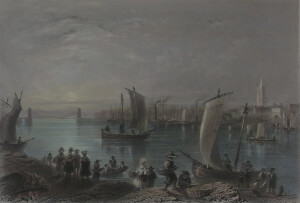 | SHORT DESCRIPTION: The image shows Montrose, Scotland looking across the River South Esk from Inchbraoch. In the foreground there are men and women on shore, many with baskets. There are several small sail boats in the water and a steamship with a funnel and side paddlewheel, and to the left is the suspension bridge. The city of Montrose is in the background with buildings lining the waterfront, and the steeple of the Old and St. Andrew’s Church rising above them. NOTES: The image is from before page 37 of volume 2 of “The Ports, Harbours, Watering-Places, and Coast Scenery of Great Britain," published by George Virtue in 1842. (TMMP Library DA625 .F49 Rare) The book was first published in 1838 by Charles Tilt with descriptions by William Andrew Chatto. It was then published several times in 1839 and 1842 by George Virtue, and later after 1855 by Virtue & Co. under George’s son, James S. Virtue. The name also changed slightly, but kept the "Ports, Harbours, and Watering Places" part of the title. The books that the Virtues published kept Chatto’s descriptions for the first volume, but they expanded the book to two volumes. William Beattie wrote the text for the new second volume and an appendix added to the end of the volume 1. NOTES: This image first appeared in volume 2 of "Scotland Illustrated," before page 167. William Beattie wrote this book, which George Virtue published in 1838. NOTES: The current Old and St. Andrew’s Church building was constructed between 1791 and 1793 when it was dedicated. Gillespie Graham designed the current bell tower, which replaced an earlier one in 1834. The church is a merger of five different churches that formed over the years. The suspension bridge is one in a line of bridges that crossed the River South Esk. The first was built in 1795 and called the Timber Brig, but the wood structure did not hold up well. That was replaced in 1829 by the suspension bridge seen in this print. It was designed by Capt. Samuel Brown, and stood until 1930 when modern traffic required a more modern bridge. The 1930 bridge was then replaced in 2006. NOTES: An excerpt from The Ports, Harbours, Watering-Places, and Picturesque Scenery of Great Britain about the print. “Montrose, a royal burgh and sea-port town of Forfarshire, is agreeably situated on a level plain, or peninsula, bounded on the north-east by the German Ocean, on the south by the river South Esk, and on the west by a large expanse of this river, called the Basin of Montrose. […] The principal manufactures carried on in Montrose are the spinning and weaving of flax, for this purpose there are several steam-mills for spinning, and one of the North Esk driven by water. These steam-mills produce annually upwards of 800,000 spindles. There are also in the town soap, starch, rope and sail manufactories; and others for making steam-machinery. Ship building is carried on to a considerable extent, and there is a patent slip, introduced for repairing ships. There are also various breweries, tan-works, candle-works, a foundry and a steam-mill for grinding meal and flour. […] The principal foreign imports into Montrose consist of flax, hemp, tallow, whale fins and oil, fir timber, oak and oak-planks, deal and deal-ends. But as the goods are manufactured here are sent coastwise to London, Glasgow, Dundee, and other towns, there are few or no exports to foreign places from Montrose. Owing, however, to the bonded system having been extended to this ports, nearly all of the foreign wines and spirits consumed in the district, are brought coastwise to the bonded warehouses, and pay duty at the Custom-house when taken out for consumption. The exports from this district by the coasting-trade consist of wheat, oats, barley, rye, peas, beans, and potatoes; salmon, codfish, and pork, the latter chiefly for the London market: great coal, Culm, parret, lime, blue slate, iron, tallow, rosin, barilla, kelp, salt, and herrings from the Moray Frith [sic], chiefly smoked and sent to Hull and London markets. The principal import from the English coast is coal; but various other articles are imported and exported by regular traders to London, Glasgow, and Leith.” ADDITIONAL INFORMATION: Beginning in the 17th century, Montrose began to export many of its goods like wheat and barley to Europe and imported flax and timber from the Baltic and salt, fruit and wine from France and Portugal. Both the North Esk and the South Esk rivers enter the North Sea at Montrose. NOTES: From the end of the 1842 edition of Volume 2: “In taking leave of these two Volumes, illustrating the Ports, Harbours, Watering-places, and Coast Scenery of Great Britain, a few words of explanation appear necessary. The work was originally commenced by Messrs. Finden [William and Edward], and for some time carried on with all the taste and spirit characteristic of these distinguished Artists. But the remuneration accruing from the sale being found inadequate to defray the expenses incurred in its production, it was offered to the present Publisher, who readily saw the improvements of which it was susceptible and became the purchaser. Arrangements were then made for its continuation. Mr. BARTLETT, whose illustrations are so familiarly and favourably known to the Public, set out on a tour of observation along the northern coasts of England and Scotland; and, after visiting every locality indicated, returned with a portfolio of drawings taken on the spot. These were immediately placed in the hands of eminent engravers; a re-issue and continuation of the work were announced; and it is gratifying to state, that the reception which it has since met with from the Public has been most liberal. With regard to the letterpress descriptions, I beg it to be expressly understood that the labours of my pen have been confined to the Second Volume and the Appendix of Vol. 1. The First Volume was written under the signature W.A.C. - prior to my connexion with the work; and, in justice to that author, I feel it at once a duty and a pleasure to conclude the work with this statement. William Beattie, M.D.” January 1842 J. Rickerby, printer, Sherbourn Lane | CL16323 | |||||||
| 3 | 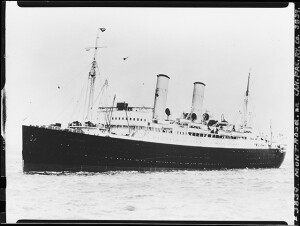 | After 1922 | Montrose (Turbo steamship : 1922). | #3839. Montrose. BR Can. Pac. RY. Co. 3839. | Ships.; Bodies of water. | Broadside view of the Montrose in midstream. | P0006/02.01-02.1546#01 | |||
| 4 | 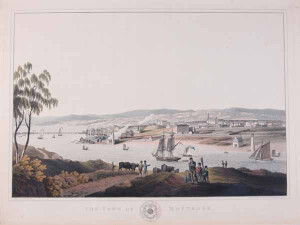 | THE TOWN OF MONTROSE | CL18529 | |||||||
| 5 | No image URL. | Canadian Pacific Steamships Ltd.; Montrose (Turbo steamship : 1922). | Canadian Pacific - Montrose (2) - postcards | MS0528/01-016.19 | ||||||
| 6 | No image URL. | 1915 | Caption: "Marshall Pass, COL. D.& R.G. Station" | MS0003/-003.847 | ||||||
| 7 | No image URL. | Montrose W. Houck | P0001.011/01-2217 | |||||||
| 8 | No image URL. | Montrose (Attack transport : APA-212). | Contains black and white photographs. | MS0817/01-20.183 | ||||||
| 9 | No image URL. | Canadian Pacific Railway Company.; Montrose (Screw schooner : 1897). | Canadian Pacific - Montrose (1) - photographs | MS0528/01-016.18 | ||||||
| 10 | No image URL. | NOTES: Object file shows information about two different vessels named HERTA MAERSK. The first built in 1939, later renamed MONTROSE. The second is a motorship built in 1943, renamed PUIG CHOU. | CL4210 | |||||||
| 11 | No image URL. | VESSEL INFORMATION - VESSEL NAME: MONTCALM VESSEL TYPE: PASSENGER STEAMSHIP, BRITISH, TWO MASTS, TWO FUNNELS SHIP OWNERS: CANADIAN PACIFIC LINE SHIPBUILDER: JOHN BROWN & CO. LTD. BUILDER LOCATION: CLYDEBANK, GLASGOW VESSEL HISTORY: SISTER SHIPS, MONTCLARE AND MONTROSE. | CL10154 | |||||||
| 12 | 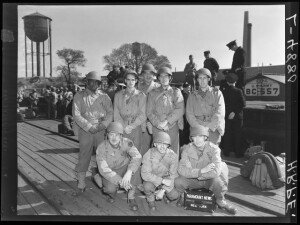 | 10/23/1943 | "L4880 - War correspondents pier 3. 10-23-43 Official photograph U.S.Army Signal Corps, HRPE, Newport News, Va."; stamped in red "Secret" | War correspondents–Virginia–Newport News.; Embarkation (Military science).; Portraits, Group–Virginia–Newport News. | A group of eight war correspondents together before embarking on pier 3. | P0003/01-#L-4880 | ||||
| 13 | 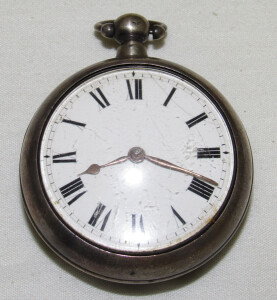 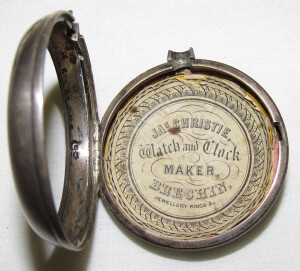 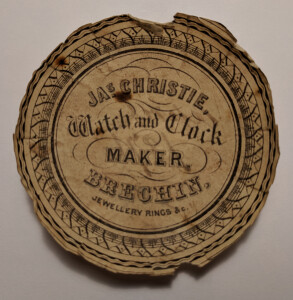 | NOTES: Complete with watch papers (five). Two from James Christie (Brechin, Scotland), one from Alexander Smith (Inverbury, Scotland), the next by Archibald Watt (Aberdeen, Scotland) and another from a watchmaker by the name of George Hamilton (Montrose, Scotland). These papers were used to record the repair date and advertise the watch repairer. There are four hallmarks in the case: uncrowned lion's head (London, England, 1822- present); silver standard mark for sterling .925; date mark for 1828; GR in oval for George Reid (first half of the 19th century) 02/01/2018: Currently displayed hanging in IS 463. | CL3143 | |||||||
| 14 | No image URL. | Nautical paraphernalia–Periodicals. | Title from cover. | LB107526 | ||||||
| 15 | No image URL. | My ditty box | LB7602 | |||||||
| 16 | No image URL. | The prevention of graft in officers' messes. | LB62942 | |||||||
| 17 | No image URL. | Selling to the service. | LB63179 | |||||||
| 18 | 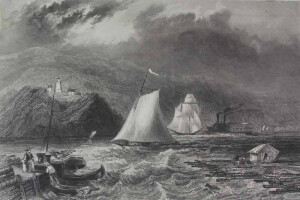 | NOTES: Piece appears to have been cut down. SHORT DESCRIPTION: The image shows the Hudson River, viewed from Montrose and looking across the water at Caldwell’s Landing, now Stony Point, New York (NOT Jones Point as many websites state). In the foreground on the left is a pier or quay, with a man standing on it and another man standing in a small rowboat pulled alongside. There is also a possible canoe and a single-masted sloop docked there. In the Hudson River the water is rough, and there is a large raft on the right with a small room built on top. In the middle of the river are two sailing ships with full sails from the wind, and on the right in the distance is a steamboat. The background is filled with hills and mountains, and the Stony Point Lighthouse is perched on the side of one of them. NOTES: The Stony Point Lighthouse was built in 1826 to mark the entrance to the Hudson Highlands, a particularly treacherous stretch of the river. It is the oldest lighthouse on the Hudson River and was necessary because the Erie Canal greatly increased the amount of traffic on the river. Thomas Phillips designed the octagonal tower, and after her husband’s death Nancy Rose went on to become the longest-serving lightkeeper from 1857 until her own death in 1904. NOTES: This print is engraved by A.L. Dick and is from “The Ladies’ Companion,” on page 102 of the January 1841 edition of the magazine. The image appeared earlier in Nathaniel Parker Willis’ book, “American Scenery” published by George Virtue in 1840, but that print was engraved after Bartlett by H. Adlard, so the museum’s print is not from this book. Excerpt from the magazine: “The subject of our present engraving is a spot most memorable in the annals of the American Revolution. At the landing below the rock, on which the light-house is situated, is a mountain known by the name of Long Clove, at the base of which the traitor [Benedict] Arnold and the unfortunate [John] Andre held their first interview...There is, perhaps, no part of the banks of the majestic Hudson, where the garment of nature appears more lovely than the view represented in our engraving. Thick and variegated foliage clothes the banks down to the river’s edge, whose waters are for ever circling and eddying in a thousand fantastic and glittering forms. On the summit of the rock which overlooks this portion of the landscape, rises the light-house, casting its watch-flame in one long unbroken streak of silvery brilliance, while the numerous boats, pinnaces, and other craft, like so many floating cloudlets floating to and fro, render it a scene of most bewitching loveliness. Cleaving away amidst the towering highlands, and looking back, you still behold the line of light gleaming in your wake, and the beacon rising against the midnight sky like a kindled altar of oriental glory…” | CL15782 | |||||||
| 19 | No image URL. | Bounty (Ship : 1787) | Oceania–Description and travel; Oceania–Description and travel–Early works to 1800 | Sea adventure. | The journal of Bounty's launch __ __by William Bligh, Lt. Royal Navy ; annotated and illustrated by A. Richard Mansir | LB6992 | ||||
| 20 | No image URL. | United States–Commerce–Periodicals. | Merchant marine–United States–Periodicals. | Caption title. Editor: 19??-1937 M.M. Stewart. | LB4446 | |||||
| 21 | 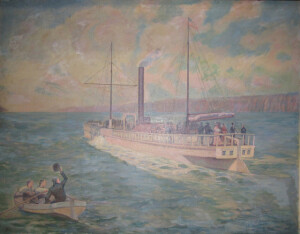 | NOTES: This image does not show the North River Steamboat built by Fulton in 1807 it shows the operating replica that was built for the Hudson-Fulton celebration in 1909. See the record for the model MD13/1933.0019.000001 for details. VESSEL INFORMATION - VESSEL NAME: CLERMONT (ii) (SEE "VESSEL HISTORY" BELOW) ALL NAMES OF VESSEL: CLERMONT NATIONALITY: United States HOME PORT: New York, New York VESSEL TYPE: Replica, Passenger Steamboat SERVICE DATES: 1909- SHIPBUILDER LOCATION: New York, New York; New York, Indian Point SHIP OWNERS: Hudson-Fulton Celebration Commission (?); Hudson River Day Line SHIP LINE OR OPERATOR: Hudson River Day Line CAPTAINS OR OTHER RELATED PEOPLE: Kirby, Frank E. (naval architect; designer of replica) MAJOR EVENTS: Hudson-Fulton Celebration, 1909 VESSEL HISTORY: Built for the 1909 celebration; later based at Indian Point Park in Montrose, New York, an amusement park operated by the Hudson River Day Line as a destination for passengers (now the site of a nuclear power plant). "Clermont," the name of Robert R. Livingston's estate on the Hudson River, has been popularly but incorrectly used as the name of the original boat. It was the formal name for the 1909 replica represented accurately by this model. ASSOCIATED (RELATED?) PLACES: New York, Albany/ New York, Clermont RELATED VESSELS: North River Steamboat, 1807/ North River Steamboat Of Clermont, 180/ Clermont 19__, Hudson River excursion steamer. | CL755 | |||||||
| 22 | No image URL. | Chris-Craft Industries–Archives.; Murray Industries. | Boatbuilding.; World War, 1939-1945–Naval operations. | This collection, considered to be one of the most complete histories of a boating company, has at its core the company archives of Chris Smith & Sons Boat Company and its successor organizations of Algonac, Michigan. Material related to this company donated subsequently has been included in this collection. --Chris-Craft boats were manufactured by variously named companies headed by the person and family of Christopher Columbus Smith of Algonac, Michigan. The first company was Chris Smith & Sons Boat Company, formed in 1922. That name was changed in 1930 to Chris-Craft Corporation, which persisted until the company was bought by NAFI Corporation in 1960. In 1962, the NAFI Board of Directors changed the name of the Chris-Craft Corporation to Chris-Craft Industries. By the end of 1962, NAFI had purchased the Thompson Boat Company of Cortland, New York, marking the first acquisition of other another boat company, and Chris-Craft Corporation had become the Chris-Craft Division. Other divisions included the Corsair Division, the Roamer Division, the Cavalier Fleet, the Sea Skiff Division, the Sailboat Division, the F.G. Division, the Corporate Research and Development Division, and the Parts Division. By 1965, there were 3 overseas subsidiaries: Chris-Craft Canada, Chris-Craft S.A., in Lausanne, Switzerland, and Chris-Craft S.p.A. of Fiumicino, Italy. In 1966, Thompson boat models were discontinued. In 1968, Chris-Craft Industries merged with Baldwin-Montrose Chemical Company of New York City. That same year, the Houseboat Division was started. By 1969, the Parts Division moved into a remodeled Engine Division. In 1980, the Boat Division was sold to Murray to form Murray Chris-Craft. --During the 1980s, the company was gradually sold off. Chris-Craft Sales, the mail order business, was sold to Leisure Sports Wear. The Parts Division, still at Algonac, and the Marine Motors in Gallipolis, OH, were finally sold to U.S. Marine in 1986. __The collection contains information on all models produced by Chris-Craft Industries and includes the following major components. Approximately 100,000 boat equipment records document the original standard and optional features of each hull produced. Details such as the hull number, model, engine type, paint color, upholstery, place of construction, original dealer, and other hardware features are included. More than 15,000 photographs illustrate the early Gold Cup racers, boat construction, dealer showrooms, marine engine production, and celebrity Chris-Craft owners, in addition to the many and varied models of runabouts and cruisers produced by the company. More than 50,000 original design plans document almost every standard and customized model built, including the Cadet, Riviera, Cobra, Continental, Holiday, Sportsman, and Racing Runabout. Within the sales catalogs, price lists, and boat and engine manuals series, there is nearly a complete collection of sales and boat literature providing accurate data on boating style, pricing, and general specifications. The boat engineering data contains the only record of boat construction specifications for the post-World War II models. The engine master records contain the complete listing of Chris-Craft engine serial numbers, the boat model, date built, and the hull in which it was installed. With the advent of World War II, all Chris-Craft production converted to manufacturing a variety of landing craft and patrol boats for both Army and Navy use. This series contains correspondence, design proposals, and photographs which detail the company's wartime role. | MS0005 | |||||
| 23 | 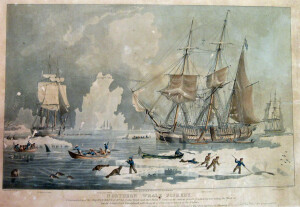 | LABEL COPY: Whaling in and near the arctic zone was carried on under numerous climatic disadvantages. The severe cold was an enemy to the hands and feet of the man at the helm and to the decks and riggings of the ice-covered ship. A compensation for these difficulties was the sluggishness and timidity of the right and bowhead whales as compared to those found in warmer waters. ADDITIONAL INFORMATION: See Lubback "The Artic Whalers", p. 135. | CL20060 | |||||||
| 24 | No image URL. | Doric (Turbo steamship : 1923).; Laurentic (Steamship : 1927).; Minnewaska (Turbo steamship : 1923).; Minnetonka (Turbo steamship : 1924).; Belgenland (Steamship : 1922).; Pittsburgh (Steamship : 1920).; Vedic (Turbo screw schooner : 1918).; Regina (Screw schooner : 1919).; Adriatic (Screw schooner : 1919).; Andania (Turbo steamship : 1922).; Montcalm (Turbo steamship : 1921).; Empress of Scotland (Steamship : 1921).; Athenia (Turbo steamship : 1923).; Marloch (Turbo steamship : 1922).; Ausonia (Turbo steamship : 1921).; Montrose (Turbo steamship : 1922).; Letitia (Turbo steamship : 1925).; Canada (Screw schooner : 1896).; Megantic (Screw schooner : 1918).; White Star Line. | Transatlantic voyages.; Ocean liners–Atlantic Ocean. | Two-part article: Part I - Titanic Commutator, volume 17, number 4, pages 13-22; Part II - Titanic Commutator, volume 18, number 1, pages 36-44. | LB108526 | |||||
| 25 | 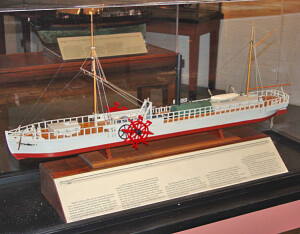 | NOTES: This is NOT a model of an 1807 steamboat named CLERMONT, as there was no such boat at that time; Robert Fulton's first successful steamboat was named NORTH RIVER STEAMBOAT and was enrolled as such on 9/03/1807 at New York (home port). After rebuilding and enlargement over the winter, she was again enrolled on 5/14/1808 as NORTH RIVER STEAMBOAT OF CLERMONT (for Robert R. Livingston's estate in the Hudson Valley), but despite this "of," implying a different home port, her official home was still New York City (see copies of both enrollments, attached to correspondence of October-November 1992, in object folder). While the boat was never officially "named" CLERMONT, it was commonly "called" that, which was reinforced by an error by Fulton biographer Cadwallader Colden many years later. This IS an accurate model of the full-sized, operating replica that was built for the Hudson-Fulton Celebration of 1909, using plans prepared for the Hudson-Fulton Celebration Committee by naval architect Frank Kirby and published as a loose back-pocket insert to Volume II of the Committee's massive report. Carrying the name CLERMONT in at least three places (as does the model) and seen by millions during a fairly long life as a tourist attraction, the replica schooled further generations into acceptance of that name as the correct one. How much (or little) the replica resembled the 1807 NORTH RIVER STEAMBOAT, or whether any resemblance is more than coincidental, is a matter for considerable debate, not to be settled here. Suffice to say that no plans of the original boat are known to exist (The Museum archives holds, as CN 14, copies of Fulton's patent drawings, but they were made two years after the first successful boat, and they include many variations of the machinery, making it difficult at best to determine which may have applied to the 1807 or 1808 boats. Other Fulton sketches of the boat under way show several variations of appearance. The Fulton patent drawings are also published in smaller format with Frederick D. Herbert's 1934 paper, "Robert Fulton's Original Drawings" [Library call #VM140 H53], and there are scale drawings by Fulton of slightly later boats, notably CAR OF NEPTUNE, in the Alofsen and Stoudinger Collections of the New Jersey Historical Society. The Museum originally cataloged the model as representing the original in its enlarged, 1808, version, but no basis is known for this statement unless from the modelmaker or something in the Hudson-Fulton Celebration material (which included much of what is now called "hype"). A research project, with drawings and photos of a model incorporating its results, was also described in "Nautical Research Journal" (vol. 33 no. 2; June 1988); the author Frederick Aeschbecher, produced a model very different from this one. VESSEL INFORMATION - VESSEL NAME: CLERMONT (ii) (SEE "VESSEL HISTORY" BELOW) ALL NAMES OF VESSEL: CLERMONT NATIONALITY: United States HOME PORT: New York, New York VESSEL TYPE: Replica, Passenger Steamboat SERVICE DATES: 1909- SHIPBUILDER LOCATION: New York, New York; New York, Indian Point SHIP OWNERS: Hudson-Fulton Celebration Commission (?); Hudson River Day Line SHIP LINE OR OPERATOR: Hudson River Day Line CAPTAINS OR OTHER RELATED PEOPLE: Kirby, Frank E. (naval architect; designer of replica) MAJOR EVENTS: Hudson-Fulton Celebration, 1909 VESSEL HISTORY: Built for the 1909 celebration; later based at Indian Point Park in Montrose, New York, an amusement park operated by the Hudson River Day Line as a destination for passengers (now the site of a nuclear power plant). "Clermont," the name of Robert R. Livingston's estate on the Hudson River, has been popularly but incorrectly used as the name of the original boat. It was the formal name for the 1909 replica represented accurately by this model. ASSOCIATED (RELATED?) PLACES: New York, Albany/ New York, Clermont RELATED VESSELS: North River Steamboat, 1807/ North River Steamboat Of Clermont, 180/ Clermont 19__, Hudson River excursion steamer. | CL576 | |||||||
| 26 | 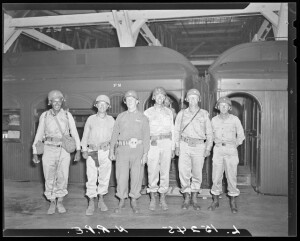 | 8/20/1945 | United States. Army–Officers.; United States. Army–Chaplains.; General G.O. Squier (Steamship : 1943).; United States. Army. Engineer General Service Regiment, 1313th.; Britannic (Motor vessel : 1930). | Colonel John H. Carruth, CE, O-3672, Lobdell, Louisiana, Regimental Commander, 1313th Engineer General Service Regiment (Shipment R5216-P), is shown with his staff on Pier 8, HRPE, Newport News, Va., soon after debarking from the USS GENERAL GEORGE O. SQUIER. Colonel Carruth was graduated from United States Military Academy, 1914; he has been awarded the Bronze Star. Left to right: Chaplain (Captain) Sanford N. Peak, O-537301, Kimball, West Virginia, Regimental Chaplain (Baptist); Captain Edward J. McManus, O-504358, Montrose, New York Engineer Officer; commissioned in Corps of Engineers at Camp Claiborne, Louisiana, November 1942; Colonel Carruth; Major George B. Cropper, O-909584, Ocean City, Maryland, joined the 1313th Engineer General Service Regiment, 25 June 1943, at Camp Claiborne, Louisiana, and went overseas 19 January 1944, embarking on the SS BRITANIC; Captain George A. Hepner, O-824625, Selins Grove, Pennsylvania; and Captain Edward T. Hickman, O-269432, Nashville, Tennessee. Photo taken for Historical purposes. | African American soldiers.; Railroad trains–Virginia–Newport News. | Group portrait of six officers standing on an HRPE in front of a troop train. The chaplain is an African American man. | P0003/01-#L-15245 | |||
| 27 | No image URL. | This series contains the boat equipment records, known simply as hull cards, and occasional Master Carpenter or Builder's Certification forms. The hull card gives individualized details of each boat manufactured and by which division within the company. The details present vary from hull card to hull card. | MS0005/01 |
Created 2026 by Don Barker, CBMM volunteer, for the Chesapeake Shipbuilding Project. shipbuilding@sailingworkboats.es